
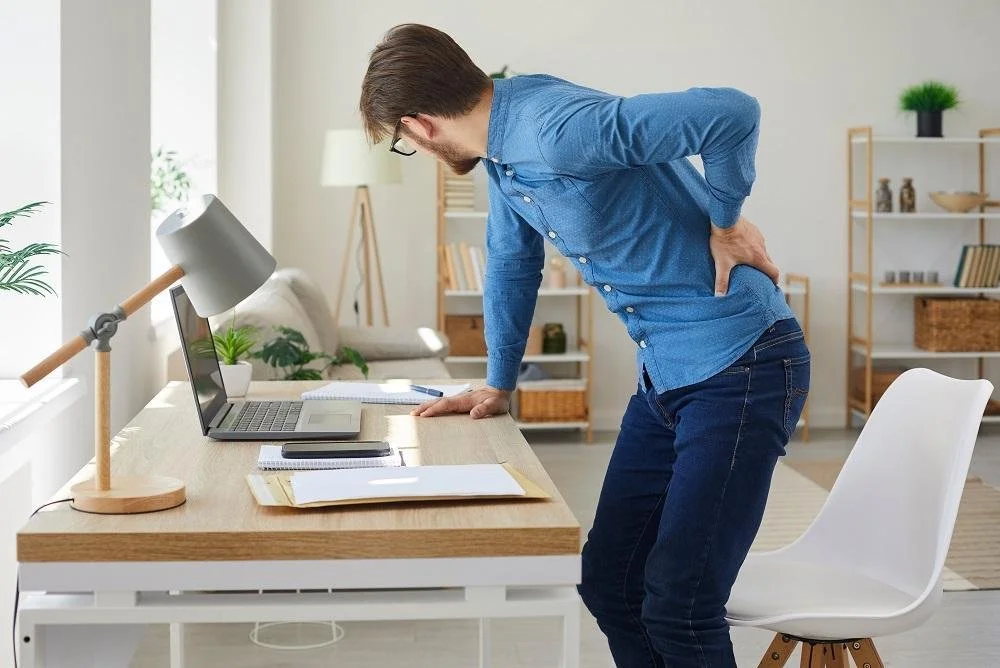
A deep, dull ache right at the bottom of your back, whether around your beltline, sacrum, or tailbone, is the hallmark complaint of modern desk work. Hours of prolonged sitting compress the lumbar discs, tighten the hip flexors, and inhibit the glutes and deep abdominal stabilizers, leaving your lower spine to absorb excessive mechanical strain.
Fixing this pain requires a two-step approach: optimizing your workstation mechanics to remove the daily stressor, and executing targeted mobility and core-stability exercises to restore balance.
Why Prolonged Sitting Causes Lower Back Pain
When you sit, pressure inside your lumbar discs increases by roughly 40% to 90% compared to standing. If you slouch or roll your pelvis backward into a posterior tilt, the natural forward inward arch of your lower spine (lumbar lordosis) flattens out.
This posture creates three specific mechanical problems:
Overstretched Posterior Ligaments: Slumping hangs your body weight on the spinal ligaments rather than using active muscular support.
Hip Flexor Tightness: Sitting locks the iliopsoas muscles in a shortened state. When you stand back up, those tight hip flexors pull directly on your lumbar vertebrae.
Glute Amnesia: Prolonged compression dulls neuromuscular activation in the gluteal muscles, forcing the lower back extensors to overcompensate during everyday movements.
How to Sit Better in an Office Chair
Good sitting mechanics are not about remaining rigidly upright like a soldier. They are about maintaining a neutral pelvis and supporting the natural curvature of your spine.
Sit on Your "Sit-Bones" (Ischial Tuberosities): Slide your hips all the way back into the chair before leaning back. Sitting on the front edge causes your pelvis to roll back and forces your lower back to round.
Adjust Lumbar Support: Position the chair’s lumbar cushion directly in the natural inward curve of your lower back, right above your belt line. If your chair lacks support, use a rolled-up towel.
The 90-to-100 Degree Rule: Set your seat height so your hips and knees rest at roughly a 90° to 100° angle, with knees slightly lower than hips. Your feet must rest flat on the floor; use a footrest if your desk height forces your feet to dangle.
Bring the Desk to You: Pull your chair close enough that your elbows rest naturally at 90° by your sides. Leaning forward toward your keyboard or monitor multiplies the gravitational load on your lower lumbar discs.
Use the 30-Minute Movement Rule: No static position is healthy forever. Every 30 minutes, perform a 20-second dynamic reset: stand up, take three deep belly breaths, gently extend backward, and sit down again.
4 Exercises to Relieve Lower Back Desk Ache
These four exercises target the exact muscle imbalances created by office work: deactivating tight hip rotators, restoring pelvic control, stabilizing the deep core, and extending a stiffened thoracic-lumbar junction.
1. Supported Deadbug Variation (Anti-Extension Core Stability)
Standard core crunches increase spinal flexion and disc pressure. The deadbug trains your deep transverse abdominis to stabilize the lumbar spine while your limbs move.
Setup: Lie flat on your back with arms reaching toward the ceiling and knees bent at 90 degrees directly over your hips (tabletop position).
Execution: Gently flatten your lower back against the floor so there is zero gap beneath your spine. Take a slow breath in. As you exhale, extend your right arm overhead and tap your left heel down to the floor, moving only from the hip.
The Key Cue: Only lower your leg as far as you can maintain your lower back firmly pressed into the mat. Return to tabletop and alternate sides.
Volume: 2 to 3 sets of 8 to 10 alternating repetitions.
2. Pigeon Stretch (Glute and Deep Rotator Decompression)
Tight piriformis and deep glute rotators pull on the sacrum and compress the sciatic pathway, generating a dull ache across the bottom of the back and buttocks.
Setup: Begin on all fours. Bring your right knee forward behind your right wrist, angling your right foot toward your left hip. Slide your left leg straight back behind you with your toes pointed.
Execution: Keep your hips squared to the floor. Lower down onto your forearms or rest your torso over your front shin until you feel a deep stretch in the outer right hip and glute.
Office Chair / Mat Modification: If the floor version strains your knees, sit upright in your office chair, cross your right ankle over your left knee (a figure-4 position), keep your spine tall, and gently lean your chest forward.
Volume: Hold for 30 to 45 seconds per side for 2 rounds. Breathe slowly into the belly.
3. Elevated Pelvic Rotations / Tilts (Lumbopelvic Mobility)
Hours of desk sitting lock the pelvis into rigidity. Performing elevated pelvic rotations while your feet or pelvis are supported restores fluid motion to the sacroiliac (SI) joints and lower lumbar facets.
Setup: Lie on your back with knees bent and feet elevated on a sturdy chair, sofa, or low bench at roughly a 90-degree angle.
Execution: Place your hands on your hip bones (anterior superior iliac spines). Gently tilt your pelvis backward to imprint your spine into the floor, then tip your pelvis forward to create a slight arch. From there, initiate small, fluid rotational shifts, lowering your right hip slightly while raising the left, moving gently through a circular or rocking motion.
The Key Cue: Keep the motion pain-free and smooth. Do not squeeze your glutes aggressively; this is a mobility reset, not a heavy strength exercise.
Volume: 10 to 12 slow circles in each direction.
4. Bird-Dog with Active Reach (Posterior Chain Integration)
The bird-dog pairs cross-body stability with active glute activation, counteracting the front-to-back slump of sitting without compressing the lower spine.
Setup: Start on your hands and knees in a tabletop position, wrists directly under shoulders and knees directly under hips. Find a neutral spine.
Execution: Brace your core as if preparing for a light tap to the stomach. Simultaneously reach your right arm straight forward and kick your left leg straight back until both are parallel to the floor.
The Key Cue: Do not arch your lower back to lift your leg higher. Drive through the heel and squeeze the glute, keeping your pelvis level like a tabletop holding a cup of water.
Volume: 2 sets of 8 reps per side, holding each extension for 2 to 3 seconds.
When to Seek Help from a Spine Physiotherapist
While mechanical soreness from desk work responds well to posture changes and mobility exercises, lower back symptoms can also stem from disc herniations, facet joint arthropathy, or nerve impingement.
Consult a spine physiotherapist if your back ache persists past two weeks, doesn't improve with rest, or is accompanied by sharp pain, tingling, or weakness radiating down your leg. Seek emergency medical care immediately if you experience sudden numbness in your groin, legs giving out, or any loss of bowel or bladder control.
Ready to Start Your Journey? Book A Physiotherapy Session With Meredith Today!
Reaching out to a physiotherapist can be the turning point in your recovery. We're here to help you get back to doing the things you love, without being held back by pain.